

Participation, Abstention and Boycott: Trends in Arab Voter Turnout in Israeli Elections
The question of the "Arab vote" arises in Israel prior to every general election. Following "Operation Cast Lead," Israel's large-scale military operation in Gaza which preceded the 2009 elections, the question shifted from "how will Arab citizens vote" to "will Arab citizens vote at all?" In this article originally published in Hebrew in IDI's online journal Parliament, Ms. Karin Tamar Schafferman explains why Arab Israeli citizens choose not to vote and how this phenomenon might play out in the 2009 Israeli elections.
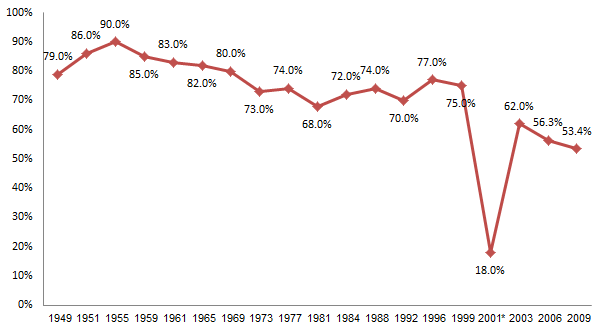
The question of "the Arab Vote" is discussed extensively in Israeli political discourse prior to every general election. While the question used to be "who will the Arab citizens of Israel vote for—a Zionist party or an Arab party," the question today is whether or not they will vote at all. The participation of the Arab citizens of Israel in Knesset elections has been on a constant decline since the 1950s (See figure 1).
Figure 1: Arab Voter Turnout in Israeli Elections, 1949-2009
(Election for Prime Minister Only)
In light of the unique circumstances leading up to the 2009 election, including a series of political developments and "Operation Cast Lead", a large-scale military operation in the Gaza Strip, it was unclear whether or not the Arab citizens of Israel would choose to exercise their democratic right and participate in the Knesset election.
Why the Arab Citizens of Israel Choose (Not) to Vote
Given the continuous decline in the participation of the Arab citizens of Israel in the Knesset elections during the last years, the question that must be posed is: why are Israel's Arab citizens choosing not to vote? There is no single clear-cut answer to this question, but it is possible to identify several reasons in order to fully comprehend this phenomenon:
- The characteristics of Israeli society and Israeli politics: Some link the decline in the participation of Israel's Arab citizens in the Knesset elections to a general trend of disinterest and indifference toward the political process that has recently characterized Israeli society and has led to a constant decline in voter turnout among all Israeli citizens.
The 1970s saw a decline in Jewish (from 85.9% in 1965 to 78.6% in 1973) and Arab voting rates (82% in 1965 to 73% in 1973). In 2003, 67.8% of the Jewish population voted in the election, compared to 62% of the Arab population. Therefore, low voter turnout in the Arab sector is not necessarily related to its ethnic background, and is part of a general decline among all Israelis. - Arab self-awareness of their status in Israel is, in general, the result of a growing political-national consciousness. The Arab public is becoming more aware of its own insignificance in Israel's political configuration and of its inability to affect government policy, despite being an inseparable part of Israeli society.
- Disappointment with Arab leadership: In recent decades—especially since the direct vote was introduced in 1996, which undermined all of Israel's political parties—the Arab political parties have grown substantially weaker and have suffered a general institutional crisis.
Furthermore, the Arab public has begun to lose faith in its Knesset representatives as a result of their inability to bring about any real change, and because they have abandoned the struggle for the day-to-day interests of the Arab citizens of Israel in favor of the nationalist Palestinian cause. - An act of protest against the political reality and the Israeli-Palestinian conflict: The Arab citizens of Israel feel that a marginal part of their complex national identity is also Palestinian. As a result, some Arab organizations oppose any type of participation in Israeli elections. One group, the "Sons of the Land", has always opposed participation in the elections because it distinguishes the Arab citizens of Israel from other Palestinians. The "Northern Faction of the Islamic Movement in Israel" also calls for the boycotting of Israeli elections, mainly for religious reasons—they claim that participation in Israeli elections is opposed to the spirit of Islam and Islamic law.
- In addition to established organizations that have always boycotted the elections for ideological reasons, current events have also led to calls to abstain from voting: in 1996, many Arab citizens of Israel boycotted the elections in response to "Operation Grapes of Wrath" in Southern Lebanon; a large boycott also followed the October riots of 2001; and "Operation Cast Lead" in the Gaza Strip significantly affected the voting patterns of the Arab public in the 2009 election.
The Participation Rate of Arab Citizens in Israeli Elections
The Fifties and Sixties: High Voter Turnout
In the 1950s and 1960s, the voting rate of the Arab citizens of Israel was very high—from 90% in 1955 to 82% in 1965. Neuberger (1965) suggests that the high turnout during these years was actually imposed by the dominant Mapai party, which took advantage of the clan social structure of the Arab population and used the military government to pressure Israel's Arab citizens to vote for Mapai's satellite parties: "The Israeli Arab Democratic List", "Agriculture and Development", "Cooperation and Brotherhood" and "Progress and Development". Therefore, the high voting rates during these years do not necessarily indicate a desire to participate, but rather fear of the Israeli regime.
Whether this theory is true or not, the involvement of the Arab citizens of Israel in parliamentary politics remained high even after the military government was withdrawn, and stood at 80% in 1966. This statistic indicates that the Arab citizens of Israel were willing to adopt the rules of Israel's political game in order to be assimilated into the political system and to change the treatment of the Arab citizens through democratic means.
The Late Seventies and Early Eighties: The First Signs of Change
Together with a rise in education and living standards, the Arab public grew more politically and socially aware. These changes affected voting patterns as well, and after many years of high voting rates, a major decline began in the 1970s. In 1973, Arab voter turnout rates dropped by 8% compared to the previous election, and the decline continued in 1981, when only 68% of the Arabs citizens of Israel exercised their right to vote.
Although these numbers are still relatively high, they signify the beginning of the Arab citizens' estrangement from Israeli politics, which is the result of the understanding that Israeli citizenship does not guarantee civil equality. Nonetheless, the high voting rates could be explained by contemporary political considerations rather than the desire to partake in Israeli politics—in the past, the majority of Arab citizens had voted for the various Mapai satellites; in the 1970s, they began to support Hadash (the Democratic Front for Peace and Equality), which called for a complete Israeli withdrawal from all the territories conquered in 1967, recognition of the PLO, the establishment of a Palestinian state alongside the State of Israel, and full and equal rights for Israeli Arabs. Hadash grew even stronger after the first Land Day in 1976, winning 5 seats in the election to the 9th Knesset. In 1984, another Arab party was established—the Advanced List for Peace, which called for the right to self-determination, and won seats in the 11th and 12th Knesset.
The nationalist awakening of the late 1970s led to an inter-Arab political struggle, which revived Arab participation in the Knesset election and maintained a relatively high voter turnout.
The Nineties: Between Participation and Abstention
In 1996 and 1999, participation in the Knesset elections among the Arab citizens of Israel increased once again in spite of a heightened political-nationalist consciousness and the understanding that they would have little, if any, effect on the coalition or on national policy. The direct vote, which was introduced in 1996, set off a heated debate among the Arab public. Some demanded a boycott of the election in response to "Operation Grapes of Wrath" in Southern Lebanon, while others advocated voting for an Arab party, but not for any candidate for Prime Minister. Although both arguments were eventually disregarded by most of the Arab population and parties, the percentage of those who chose to either boycott the election or to cast a blank ballot grew, and the question of Arab participation vs. abstention became increasingly relevant to Israeli-Arab political discourse.
The 2000s: Abstention and Boycott
The strategy of abstention was not fully implemented until the 2001 election in which only 18% of all the Arab citizens of Israel voted for Prime Minister, and one-third of the voters cast a blank ballot. The primary reason for this widespread abstention was an event that manifested the issue of discrimination—the October riots in which Israeli police forces killed 13 Arab citizens. Some protested against Prime Minister Ehud Barak by casting a blank ballot, while others, including Balad and the United Arab List (Raam), called for an all-out boycott of the election.
However, this is only a partial explanation inasmuch as voter abstention stemmed from long-term processes as well; as noted above, one of the reasons for boycotting the elections is the Arab population's growing awareness of its status as "second-class" citizens in the State of Israel. By abstaining, the Arab citizens of Israel seek to express their collective objection to the discrimination, inequality, alienation and contempt that the Israeli political system and public has shown them throughout the years. According to scholar Amal Jamal, the widespread abstention at that time was not rooted in indifference or a lack of interest, but was rather a type of reverse participation whose goal was to emphasize the importance of this population to the future of Israeli Democracy (Jamal, 2001: 60).
The claim could be made that 2001 marked a turning point in the relationship between the Arab citizens of Israel and Israel's political establishment and since then, the boycott has become a legitimate course of action among the Arab public. The fragile relationship between the Arab population and the political establishment has yet to recover, and in 2003, the decline in Arab participation in the Knesset election persisted (compared to 1999).
It seems that in 2006, abstention became boycott for the sake of boycott that was based on a well-grounded political agenda: in February of that same year, the People's Committee for Boycotting the Election published an editorial, which argued for the establishment of a separate Arab Parliament in Israel and a boycott of the Israeli election. The leaders of the "Northern Faction of the Islamic Movement in Israel" reiterated the movement's position against participating in the election, and their declaration intensified the boycott trend. In spite of several attempts to persuade the Arabs to vote for Arab parties, such as an editorial against boycotting the election and in favor of voting for Arab lists, only 56.3% of the Arabs voted in the 17th Knesset election (which was still only 7% less than the general rate among all Israelis).
The turnout in this election was labeled "an unprecedented low" because Israeli citizens consciously and deliberately chose to refrain from participating in the democratic process, effectively refusing to grant legitimacy to the ruling government.
Election 2009: Citizenship and Loyalty
The election campaign leading up to the 18th Knesset reflected some major changes in the political atmosphere and security situation, which raised questions about the loyalty of the Arabs citizens to the State of Israel, and deepened the concern that the Arab public would boycott the election once again.
- "Operation Cast Lead" in the Gaza Strip prompted an uprising among the Arab public that called for the indictment of Prime Minister Ehud Olmert, Defense Minister Ehud Barak and Chief of Staff Gabi Ashkenazi for war crimes. The Arabs' protests against the military operation and their identification with the Palestinian cause were perceived by the general public as contradictory to their status as Israeli citizens, and intensified their delegitimization.
- Intensification of the Delegitimization of the Arab Public: It appears that in response to similar events in the 1990s, the Arab public also abstained from voting in the Knesset elections in protest against the policies of Israel in the territories captured in 1967.
- The Knesset's attempt to disqualify the Arab lists—Balad and Raam-Taal—was an expression of the intensification of the delegitimization process against the Arab public, which, in its turn, was perceived as an act of racism aimed at further alienating the Arab citizens from Israeli politics.
As for the effect that this attempt had on the Arab vote, MK Wasel Taha of Balad at first declared that the Arab lists were considering boycotting the election, and MK Jamal Zahalka repeated the call to establish an alternative Arab parliament—an expression of the Arab population's sense of alienation. However, following the Supreme Court's reversal of the disqualification of these parties, the leaders expressed the hope for massive Arab voter turnout in order to "avenge" those that sought to distance them from the public arena and influential positions.
It is unclear how the disqualification affected the Arab vote since the Arab voters are dissatisfied with the Arab parties in any event: they do not join coalitions and on more than one occasion, they have even been accused of failing to represent the interests of the Arab public. - The third factor that undoubtedly affected the Arab voter turnout rate in the 18th Knesset election was the political agenda of the Israel Beiteinu Party, headed by MK Avigdor Liebermann. The party's election campaign raised the question of the citizenship of the Arabs in Israel, and portrayed their leaders as "traitors" whose salaries are paid by the Israeli tax payer.
Israel Beiteinu's slogan, "No Citizenship without Loyalty", called for passing the "Loyal Citizenship Law", which stipulated that only those who are willing to declare their loyalty to Israel as a Jewish State would be entitled to all the rights of a citizen.
Throughout the campaign, there were several conflicting conjectures concerning the effect Liebermann's campaign would have on the Arab population in Israel. Some claimed that it would intensify the delegitimization of the Arab public, ultimately causing it to refrain from voting for an institution that does not represent it and that perceives it as "the enemy". Others claimed that Israel Beiteinu's campaign would backfire and that the fear of Lieberman rising to power would ultimately encourage the Arab public to participate in the election.
Due to these three factors, and in accordance with the trend to boycott that has intensified over the past two decades, only 53.4% of the Arab citizens of Israel participated in the 2009 election—3% less than in the previous election. Almost half of the Arabs in Israel chose not to vote and not to play the democratic game.
The ever-growing trend to boycott, which is an expression of an entire public's perception of its alienation from the State, is a warning that a genuine democracy cannot afford to ignore.
Ms. Karin Tamar Schafferman is a research assistant at the Israel Democracy Institute.